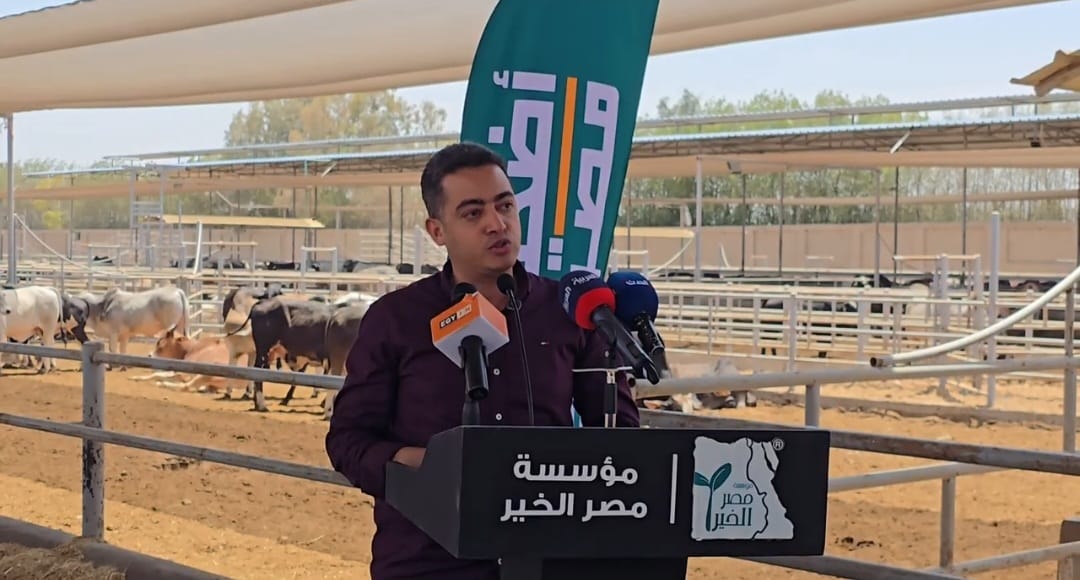
“Misr El Kheir Foundation Reaches 40% of Egypt’s Villages during Eid Days”
12 May 2026Ahmed Ali, Executive Director of Programs at Misr El Kheir Foundation, a member of the National Alliance for Civil Development Work, confirmed that the quality system within the foundation is divided into two main phases: pre-slaughter and post-slaughter. He explained that the institution handles each phase with the utmost precision to ensure that high-quality sacrificial meat reaches both beneficiaries and donors alike.
Pre-slaughter stage relies entirely on veterinary and agricultural supervision within the foundation’s farms
He explained that the pre-slaughter stage depends entirely on veterinary and agricultural supervision at the foundation’s farms, starting from the selection of livestock to the type of feed and the daily care provided to the animals.
The ultimate goal is to provide meat worthy of deserving families
He added that achieving the well-known taste of “local Egyptian meat” requires careful preparation and multiple stages of technical, agricultural, and veterinary monitoring. He emphasized that the ultimate goal is to provide meat worthy of deserving families while also giving donors confidence and pride when distributing sacrificial portions to those around them.
Every service within the foundation has what is known as a “Policies and Procedures Manual”
He pointed out that the second part of the quality system relates to slaughtering, preparation, and packaging operations. Every service within the foundation has a “Policies and Procedures Manual” that outlines the required quality standards at every stage of the project. He confirmed that the foundation reviews every step, from selecting the appropriate slaughterhouse to packaging and transportation operations, ensuring that work is carried out only in accredited government slaughterhouses operating under full veterinary supervision and official oversight.
The foundation sets precise standards for every detail within slaughterhouses and processing facilities
He added that the foundation establishes detailed standards for all aspects inside slaughterhouses and processing plants, starting from specially prepared flooring designed to prevent bacterial growth, to cutting and draining tables, freezing tunnels, refrigeration units, and even the type of packaging bags used. Every component undergoes approval and monitoring by specialized authorities before use.
He revealed that the foundation operates through more than 120 approved sources, including slaughterhouses and certified entities, in addition to a network of more than 1,500 civil society organizations across various governorates. He confirmed that work teams reach no less than 35–40% of Egypt’s villages during the four days of Eid al-Adha meat distribution.
He explained that the government slaughterhouses cooperating with the foundation are subject to continuous veterinary supervision, and meat is not stamped or approved until its safety and suitability for human consumption are confirmed. He stressed that health and veterinary standards represent a top priority for the foundation.
Criteria for selecting sacrificial animals
Regarding the criteria for selecting sacrificial livestock, Ahmed Ali confirmed that the foundation relies on specific religious and technical standards. He explained that the minimum acceptable weight is approximately 420 kilograms in order to ensure high meat yield and superior meat quality.
He added that animals weighing less than 350 kilograms are still in the skeletal growth stage and therefore do not provide the required quality or optimal meat yield.
The foundation focuses primarily on local meat
He pointed out that the foundation places greater emphasis on local meat. Some breeds may originate from outside Egypt at a young age, but they are raised on Egyptian farms for periods of two months or more, fed on local feed, and eventually acquire the characteristics and flavor of traditional Egyptian local meat. This distinguishes them from imported meat, which is slaughtered directly at the borders before entering the country.
He emphasized that donors and citizens consistently show the highest demand for local meat because of its superior quality and distinctive taste. This is why Misr El Kheir Foundation is keen to expand this type of sacrifice within its annual campaigns.
The foundation complies with Egyptian law regarding slaughter operations
He added that the foundation complies fully with Egyptian law concerning slaughter operations, relying exclusively on male livestock for sacrifices, while the slaughter of females is prohibited except in specific cases and with official veterinary certificates, in order to preserve livestock resources and comply with applicable regulations.
He concluded by affirming that the quality system at Misr El Kheir Foundation goes beyond simply providing good meat. It also aims to maintain donors’ trust and ensure that safe and healthy products reach deserving families across all governorates according to the highest approved veterinary and technical standards.



.png)
.png)
.png)
.png)
